Quiet Night Thoughts
Twenty characters turn a patch of moonlight into the plainest and most universal homesickness in Tang poetry.
701–762
Poet Immortal · styled Taibai · known as Qinglian Jushi
A working English profile of Li Bai, compiled from the Chinese poet archive on Songci.China: key dates, selected poems and notes on how the poet is often misread.
Li Bai (701–762), styled Taibai and known as Qinglian Jushi, is the poet most closely associated with the romantic strain of High Tang verse, and later generations gave him the name "Poet Immortal." According to the site's chronology he was born at Suiye, a Silk Road garrison town in the Tang protectorate of Anxi, near present-day Tokmok in Kyrgyzstan, and moved with his family to Jiangyou in Sichuan at the age of five. There he received a classical education. At twenty-five he left home and travelled down the Yangtze, writing on Mount Emei and at Jingmen on the way. Over the following years he stayed in Yangzhou, married into the family of a former chancellor at Anlu, visited Meng Haoran in Xiangyang, and saw him off at the Yellow Crane Tower.
In 742 he was summoned to Chang'an and served as a Hanlin literary attendant; he left in 744, and the site describes the years that followed as a period of imperial dismissal and wandering. The An Lushan Rebellion drove him into retreat at Mount Lu, and his connection with Prince Yong's staff led to exile toward Yelang in 759. Pardoned on the road at Baidicheng, he turned east again and died at Dangtu in 762. His poems often turn on a single vivid scene — moonlight in a room, spray from a waterfall, a sail disappearing downriver — and then shift suddenly into longing, defiance or relief.
Born at Suiye, a Silk Road town in the Tang Anxi Protectorate
Suiye (near present-day Tokmok)Moved with his father to Jiangyou at five and began a classical education
Jiangyou, SichuanLeft Sichuan at twenty-five; wrote "Ode to the Moon over Mount Emei" and "Farewell at Jingmen Ferry"
Mount Emei and JingmenStayed in one of the busiest commercial cities of Tang
YangzhouMarried the granddaughter of former chancellor Xu Yushi and lived at Anlu for about a decade
Anlu, HubeiVisited Meng Haoran at Xiangyang; saw him off at the Yellow Crane Tower
Xiangyang and the Yellow Crane TowerSummoned to the capital and appointed a Hanlin literary attendant
Chang'an (Xi'an)Met Du Fu in 744; after their reunion in 745 he settled by the Bamboo Stream with five companions, the "Six Eminents"
The Liang-Song plain and Mount CulaiClimbed the Phoenix Terrace in the old Six Dynasties capital
Jinling (Nanjing)Lived at Qiupu for several years and wrote the seventeen "Songs of Qiupu"; visited Taohuatan at Wang Lun's invitation
Qiupu and TaohuatanTook refuge at Mount Lu after the An Lushan Rebellion broke out
Mount Lu, JiangxiExiled toward Yelang; pardoned at Baidicheng and wrote "Departing Baidicheng Early"
Baidicheng (Fengjie)Visited Caishiji, where legend says he drowned reaching for the moon; died at Dangtu in 762, aged sixty-two
Caishiji and DangtuThese notes are reproduced verbatim from the Songci.China poet archive. They are the archive's English wording, not a fresh translation, so the detail and emphasis follow the Chinese record rather than this page's own summary above.
In the first year of Chang'an (701) during the reign of Empress Wu, Li Bai was born in Suiye (near present-day Tokmok, Kyrgyzstan), an important town in the Anxi Protectorate of the Tang Dynasty and a key node on the Silk Road
Suiye (present-day Tokmok, Kyrgyzstan)In the second year of Shenlong (706) during Emperor Zhongzong's reign, when Li Bai was five years old, he moved with his father Li Ke and the entire family to Changlong County, Mianzhou (present-day Jiangyou, Sichuan) in Jiannan Circuit to settle down. Here, Li Bai spent his childhood and adolescence, beginning to receive traditional Confucian education
Jiangyou (present-day Jiangyou, Sichuan)In the 13th year of Kaiyuan (725) during Emperor Xuanzong's reign, Li Bai, 25 years old, left Sichuan with the ambition to 'go to the country with a sword, bid farewell to his family and travel far'. He began his journey roaming the world. He first ascended Mount Emei and wrote the famous poem 'Ode to the Moon over Mount Emei'
Mount Emei (present-day Emeishan, Sichuan)In the 13th year of Kaiyuan (725) during Emperor Xuanzong's reign, after leaving Shu, Li Bai sailed down the Yangtze River and passed through Jingmen. Here, he wrote the famous poem 'Farewell at Jingmen Ferry', expressing his reluctance to leave his hometown and his expectations for the future
Jingmen (present-day Jingmen, Hubei)In the 14th year of Kaiyuan (726) during Emperor Xuanzong's reign, Li Bai arrived in Yangzhou. At that time, Yangzhou was one of the most prosperous commercial cities in the Tang Dynasty. Li Bai spent a period of carefree time drinking wine and composing poems here, writing many famous works.
Yangzhou (present-day Yangzhou, Jiangsu)In the 15th year of Kaiyuan (727) during Emperor Xuanzong's reign, Li Bai married the granddaughter of the former prime minister Xu Yushi in Anlu, beginning a life of 'drinking and seclusion in Anlu, wasting ten years'. During these ten years, Li Bai enjoyed family life on the one hand and actively sought opportunities to enter officialdom on the other.
Anlu (present-day Anlu, Hubei)In the 16th year of Kaiyuan (728) during Emperor Xuanzong's reign, Li Bai traveled to Xiangyang and formed a deep friendship with Meng Haoran. Here, he wrote poems such as 'To Meng Haoran'.
Xiangyang (present-day Xiangyang, Hubei)In the 18th year of Kaiyuan (730) during Emperor Xuanzong's reign, Li Bai bid farewell to his good friend Meng Haoran at the Yellow Crane Tower. Here, he wrote the eternal masterpiece 'Seeing Meng Haoran Off to Guangling at Yellow Crane Tower', expressing his deep friendship with his friend.
Yellow Crane Tower (present-day Wuhan, Hubei)In the first year of Tianbao (742) during Emperor Xuanzong's reign, Li Bai was summoned to Chang'an to serve as an academician in the Hanlin Academy, becoming Emperor Xuanzong's literary attendant. This was the peak period of Li Bai's political career, and he wrote the lines 'Looking up to the sky and laughing as I go out; are we the kind of people who grow in the weeds?' to express his joy.
Chang'an (present-day Xi'an, Shaanxi)In the 4th year of Tianbao (745) during Emperor Xuanzong's reign, after leaving Chang'an, Li Bai met with poets such as Du Fu and Gao Shi at Mount Culai in Shandong. They drank wine, composed poems, and became good friends, known as the 'Six Hermits of Bamboo Stream'. During this period, Li Bai's poetic creation became more free and unrestrained, writing many bold and unrestrained works.
Mount Culai (present-day Tai'an, Shandong)In the 6th year of Tianbao (747) during Emperor Xuanzong's reign, after leaving Chang'an, Li Bai roamed the south of the Yangtze River and arrived in Jinling (present-day Nanjing). Here, he wrote famous poems such as 'Ascending the Phoenix Terrace in Jinling'.
Jinling (present-day Nanjing, Jiangsu)In the 12th year of Tianbao (753) during Emperor Xuanzong's reign, Li Bai roamed Qiupu and wrote the famous 'Seventeen Songs of Qiupu' here, depicting the natural scenery of Qiupu and the lives of the working people.
Qiupu (present-day Guichi, Anhui)In the 14th year of Tianbao (755) during Emperor Xuanzong's reign, Li Bai traveled to Taohuatan and formed a deep friendship with the villager Wang Lun. Here, he wrote the famous poem 'To Wang Lun'.
Taohuatan (present-day Jingxian, Anhui)In the 15th year of Tianbao (756) during Emperor Xuanzong's reign, after the outbreak of the An Lushan Rebellion, Li Bai secluded himself on Mount Lu. During this period, he wrote many famous landscape poems, expressing his love for nature and yearning for a peaceful life.
Mount Lu (present-day Lushan, Jiangxi)In the second year of Qianyuan (759) during Emperor Suzong's reign, Li Bai was exiled to Yelang (present-day Tongzi area, Guizhou) due to the case of Prince Yong Li Lin. When he arrived at Baidicheng, he was pardoned. He immediately set sail downstream and wrote the famous poem 'Departing Baidicheng Early', expressing his joy after being pardoned.
Baidicheng (present-day Fengjie, Chongqing)In the 2nd year of Shangyuan (761) during Emperor Suzong's reign, Li Bai traveled to Caishiji and left many legends here. It is said that Li Bai fell into the water here while drunk trying to catch the moon, becoming a story passed down through the ages.
Caishiji (present-day Ma'anshan, Anhui)In the first year of Baoying (762) during Emperor Daizong's reign, Li Bai went to Dangtu to take refuge with his clan uncle Li Yangbing, and died there in the eleventh month of that same year at the age of 62. Dangtu became the last stop of Li Bai's life and the end of his poetic creation.
Dangtu (present-day Dangtu County, Anhui)The Caishiji entry is a legend and is marked as such in the archive; it is not a historical account of his death.
Twenty characters turn a patch of moonlight into the plainest and most universal homesickness in Tang poetry.
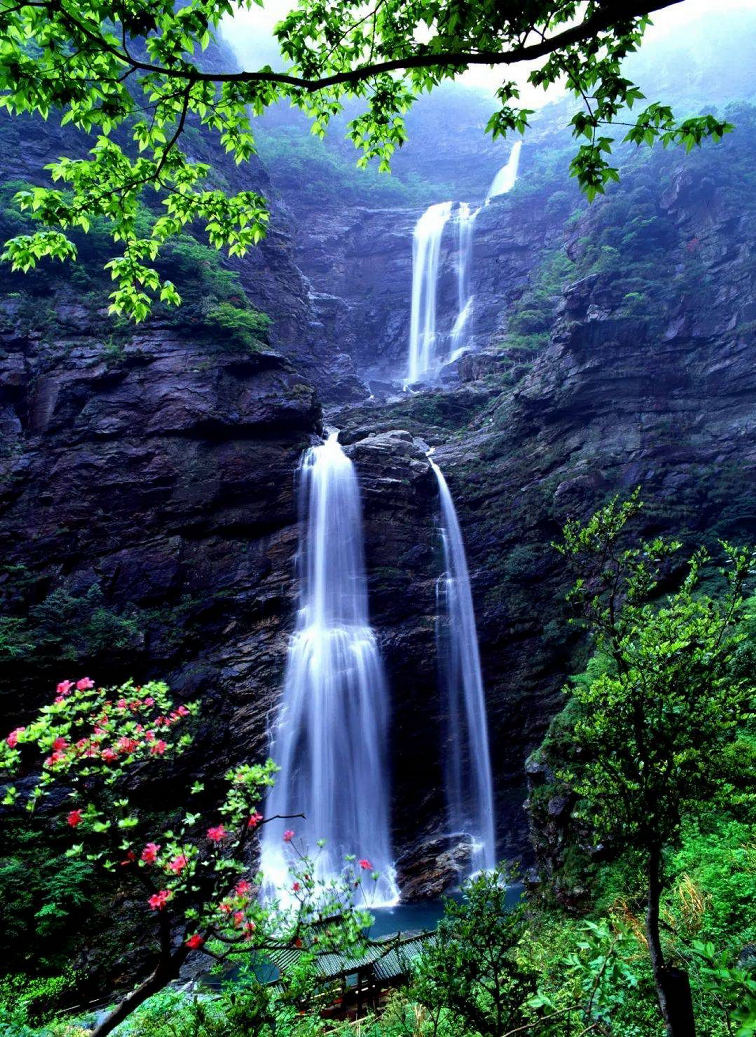
A waterfall seen from below, its spray rising like purple smoke — landscape turned into pure momentum.
A farewell that ends with a sail vanishing into empty river and sky, friendship measured by distance.
Written after his pardon on the road to exile, it makes a downstream boat ride feel like release itself.
The great drinking song, in which time, money and disappointment are answered with one enormous toast.
He was not simply a carefree wanderer. The chronology shows a sustained pursuit of office — a marriage into a former chancellor's family, a summons to the Hanlin in 742, and later a political entanglement that led to exile.
The story that he drowned at Caishiji while trying to grasp the moon is a legend, marked as such in the site's own text; it should not be presented as his cause of death.
The site places his birth at Suiye on the Silk Road, with Jiangyou as his childhood home from the age of five; "Sichuan-born Li Bai" is a simplification.
Follow the full route: 17 stations from Suiye to Dangtu, with an annotated map and a note on each place.
Open the journey mapThe same record plotted station by station: 17 places from Suiye to Dangtu, each with its year and the site’s own note.
The poet he met at Luoyang in 744, and the other voice of High Tang verse.
Three centuries later: a Song official whose exiles produced the Red Cliff works and the Dongpo name.
The Chinese-language poet page this profile summarises, with the poems in full.